

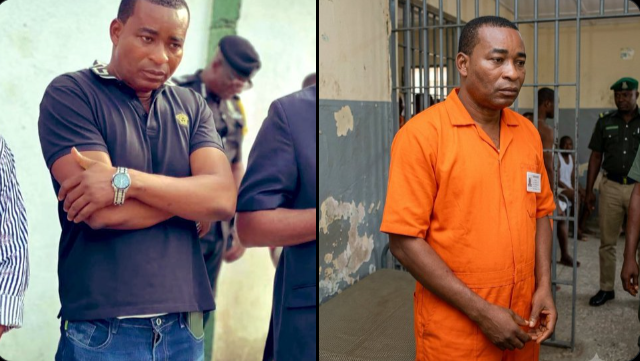
Professor Stephen Kwaku Asare (Kwaku Azar), a US-based Ghanaian academic and legal scholar, in a post on Facebook has broken down the jail sentence of the Ashanti Regional New Patriotic Party (NPP) Chairman Bernard Antwi-Boasiako, popularly known as Chairman Wontumi.
In a detailed write-up, Professor Kwaku Azar gave an overview of the case from its commencement to the ruling and the stance of all the parties in the case.

Professor Kwaku Azar disclosed that the case was basically about illegal mining activities on the mining concession of Wontumi’s Akonta Mining, which he claims was done by a third party, Henry Okum.
According to Wontumi, he only contracted Henry Okum to reclaim the land.
In Kwaku Azar’s eleventh point, he explained why the court rejected Wontumi’s defence, asserting that the judge concluded that Wontumi knowingly authorised both the mining and the reclamation on the Akonta Mining concession.
Read his full post below:
“The Wontumi Judgment Without Tears
1. The Judgment in Brief: The High Court accepted the prosecution’s case that Wontumi knowingly allowed Henry Okum to mine on Akonta Mining’s concession without the Minister’s approval. It rejected the defence that Henry Okum had been given permission only to reclaim degraded land by planting coconut trees.
The Court further held that Wontumi was the effective controlling mind of Akonta Mining, convicted both him and the company on the relevant counts, sentenced Wontumi to concurrent 20-year prison terms, fined the company, and ordered the forfeiture to the State of the equipment and other items seized from the concession.
2. What was this case about? The central question was whether Wontumi and Akonta Mining unlawfully allowed another person to use Akonta Mining’s mining concession without the Minister’s approval and, in doing so, deliberately facilitated unlawful mining.
The prosecution said they did. The defence said Wontumi never authorised mining. He only allowed Henry Okum to reclaim degraded land by planting coconut trees. If Henry Okum mined illegally, he acted entirely on his own.
3. Who were the accused? A1: Bernard Antwi Boasiako (Wontumi); A2: Kwame Antwi. He never appeared before the Court and remained at large, so the judgment made no determination of his guilt; A3: Akonta Mining Company Ltd.
4. What offences were charged?
The prosecution brought six counts, but they were based on only two offences repeated against different accused.
First offence: Allowing another person to use a mining concession without the Minister’s approval. A mining lease gives its holder the exclusive right to mine within a particular concession. Because those rights are granted by the State, they cannot be transferred, shared, or otherwise dealt with without the written approval of the Minister.
The prosecution alleged that Wontumi and Akonta Mining allowed Henry Okum to use Akonta Mining’s concession without obtaining that approval.
Second offence: Deliberately facilitating unlawful mining. The law does not punish only the person who actually carries out illegal mining. It also criminalises intentionally helping, encouraging, or enabling another person to breach the mining laws. The prosecution alleged that Wontumi and Akonta Mining deliberately enabled Henry Okum and his workers to mine on the concession without lawful authority.
5. What did the prosecution have to prove? The burden of proof rested entirely on the prosecution. That meant it had to prove every element of every offence; the accused had no obligation to prove innocence; and if there was a reasonable doubt, the accused had to be acquitted. The standard of proof was beyond a reasonable doubt.
6. What evidence did the prosecution rely on? The prosecution called four witnesses. Henry Okum testified that he approached Wontumi, obtained permission to mine on the concession, and agreed that part of the gold proceeds would finance land reclamation.
Michael Gyadu Ayisi supervised operations on the site. He testified that he worked for Henry Okum and confirmed that mining was taking place.
A witness from the Minerals Commission confirmed that no Ministerial approval had ever been obtained and that Akonta Mining had never even applied for one.
Police officers testified that they arrested numerous workers on the concession and seized excavators, firearms, pumping machines, gold, cash, and vehicles.
7. What was the defence? The defence did not deny allowing Henry Okum onto the concession. Instead, it argued that Henry Okum was there only to reclaim degraded land; Wontumi never authorised mining; Henry Okum exceeded whatever authority he had been given; and if illegal mining occurred, it was done without Wontumi’s knowledge or approval.
The defence also called expert witnesses who testified that no legal assignment or dealing with Akonta Mining’s mineral rights had taken place.
8. The constitutional challenge before the judgment: Before the judgment was delivered, the defence asked the High Court to suspend the proceedings and refer constitutional questions to the Supreme Court under Article 130.
The defence argued that sections 14(1) and 99(2)(b) of the Minerals and Mining Act, and the charges based on them, were unconstitutional because they were too vague and therefore violated Article 19(11) of the Constitution, which requires criminal offences and penalties to be clearly defined in written law.
The prosecution opposed the application, arguing that no genuine constitutional issue arose.
The judge agreed with the prosecution. She explained that not every constitutional argument must be referred to the Supreme Court. A referral is required only where there is a real question of constitutional interpretation.
She held that Article 19(11) is clear, the Minerals and Mining Act adequately defines both the prohibited conduct and the applicable penalties, and that the defence was really complaining about Parliament’s drafting choices rather than raising a constitutional question.
The application was therefore dismissed.
9. How did the judge analyse the first offence? The judge broke the offence into three elements.
First: Was Akonta Mining the holder of the mining right? Yes. The mining lease belonged to Akonta Mining.
Second: Was Ministerial approval obtained? No. Everyone agreed there was no written approval, and Akonta Mining had never even applied for one.
Third: Did Wontumi “deal with” the mining right? The defence argued that allowing someone to reclaim land is not the same as dealing with a mining right.
The judge disagreed. She held that because Akonta Mining possessed the exclusive right to mine the concession, allowing another person to mine there amounted to dealing with or encumbering that exclusive right.
10. How did the judge determine whether Wontumi authorised mining?
This was the central factual issue because there was no written agreement and no independent witness to the conversation between Wontumi and Henry Okum.
The judge therefore relied heavily on circumstantial evidence and asked a simple question: Whose version, Okum’s or Wontumi’s, was more believable?
Henry Okum said he was allowed to mine and that mining would finance land reclamation. Wontumi said he authorised only land reclamation.
11. Why did the judge reject Wontumi’s explanation?
The judge gave several reasons. First, Henry Okum was already a licensed small-scale miner. The judge considered it unlikely that an experienced miner would volunteer to reclaim land for free.
Second, land reclamation costs money, yet Wontumi admitted he gave Henry Okum no money to carry it out. The judge therefore asked a practical question: How was Henry Okum supposed to finance the reclamation? Henry Okum’s answer was straightforward: by mining. The judge found that explanation more believable.
Third, Henry Okum consistently maintained throughout the trial that he mined with Wontumi’s knowledge and that the mining financed the reclamation. The judge noted that this evidence remained substantially intact after cross-examination.
Finally, the judge regarded Wontumi’s explanation that Henry Okum expected eventually to recover his costs from mature coconut trees as an afterthought.
She therefore concluded that Wontumi knowingly authorised both the mining and the reclamation.
12. Why was Wontumi personally convicted instead of only the company?
Normally, a company is legally separate from its shareholders and directors. The judge, however, found that Akonta Mining functioned differently.
She found that the second director had been absent for years; Wontumi alone controlled the company; there was no meaningful corporate governance; decisions were made informally; and the company’s affairs were conducted personally by Wontumi.
She therefore lifted the corporate veil and treated Wontumi and Akonta Mining as effectively acting as one for the purposes of these offences.
13. How did the judge analyse the second offence? The judge identified four elements.
First: Was there an underlying unlawful act? Yes. Henry Okum mined without the legal authority required by law.
Second: Did the Act provide a separate penalty for that breach? No.
Third: Did Wontumi facilitate the unlawful mining? Yes. The judge relied on Wontumi’s own admission that he allowed Henry Okum onto the concession.
Fourth: Did he act deliberately? Again, the judge answered yes. She relied on evidence that Wontumi helped Henry Okum obtain excavators, introduced him to equipment suppliers, and actively assisted the mining operation. She regarded those acts as clear evidence of intentional facilitation.
14. What did the Court ultimately decide?
The Court convicted:
Wontumi
✔ Count 1 – Allowing another person to use the mining concession without Ministerial approval.
✔ Count 4 – Deliberately facilitating unlawful mining.
Akonta Mining
✔ Count 3 – Allowing another person to use the mining concession without Ministerial approval.
✔ Count 6 – Deliberately facilitating unlawful mining.
No determination was made against Accused 2 because he remained at large.
15. What sentence did the judge impose?
The judge emphasised that illegal mining causes enormous environmental harm and that deterrence was necessary. She nevertheless took into account that the convicted parties were first offenders.
Wontumi
Count 1: 20 years’ imprisonment with hard labour; fine of 10,000 penalty units; default of payment: 3 additional years’ hard labour.
Count 4: 20 years’ imprisonment with hard labour; fine of 10,000 penalty units; default of payment: 3 additional years’ hard labour.
The prison terms were ordered to run concurrently, meaning that if the convictions stand, Wontumi serves 20 years rather than 40 years.
Akonta Mining
Count 3: Fine of 15,000 penalty units.
Count 6: Fine of 15,000 penalty units.
The fines also run concurrently.
The Court also ordered that everything seized from the concession, including excavators, vehicles, firearms, pumping machines, gold, cash, and other equipment, be forfeited to the State under the Minerals and Mining Act.
PS: Yɛde post no bɛto hɔ. Yɛnyɛ comprehension consultants.
Da Yie!”
See the post below:
@ghnow_ Police CID transfers Chairman Wontumi from the CID Headquarters to Nsawam Prison to begin his 20-year jail term after the completion of all necessary custodial and administrative procedures. #GHnow #fyp ♬ original sound – Wasako Lyrics
@ghnow_ NPP leadership arrive for press conference after Chairman Wontumi’s 20 years sentencing #GHnow #fyp ♬ original sound – Wasako Lyrics