
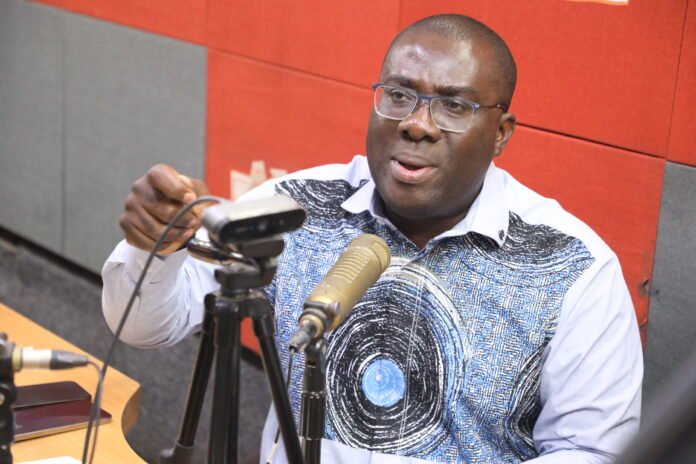
Sammi Awuku, the Member of Parliament for Akuapim North, has said there will be no Ghana Medical Trust Fund, also known as The MahamaCares, in 2029.
According to Sammi Awuku, the NPP, after they win the 2028 elections, will scrap the MahamaCares.
He highlighted that the MahamaCares is a duplication of the NHIA and its roles.
In a news card, Sammi Awuku was quoted to have said, “There will be no MahamaCare in 2029; it is a duplication of the NHIA and its roles”.
It will be recalled that in 2025, John Dramani Mahama officially launched the Ghana Medical Trust Fund, also known as The MahamaCares.
The landmark initiative aimed at providing financial assistance to individuals living with chronic diseases across the country.
The Fund seeks to cover the cost of care and medication for Non-Communicable Diseases (NCDs) not currently included under the National Health Insurance Scheme (NHIS).
In other news, Minister of Health, Kwabena Mintah-Akandoh, has disclosed that Ghana is facing a growing public health crisis, with non-communicable diseases (NCDs).
Kwabena Mintah-Akandoh disclosed that non-communicable diseases (NCDs) now account for nearly half of all deaths.
According to the Health Minister, Ghana must shift focus to early detection and prevention to curb the rising toll of these “silent killers.”
He detailed that about 42 to 45% of Ghana’s mortalities are attributable to non-communicable diseases.
Speaking on PM Express on Joy News on Monday, the Minister warned, “The NCDs are rising at an alarming rate in this country. About 42 to 45% of our mortalities are attributable to non-communicable diseases”.
“You can do the driver’s license, Ghana card, passport, and national health insurance card. Any of these that will identify you as a Ghanaian will give you access to the primary health care,” he explained.
He added, “So apart from the fact that it is going to be free at that point, what for me is going to be the game changer is the fact that we are going to move into the homes of Ghanaians to do simple screening”.
“But we must begin to trace the source. We must begin to be able to detect these conditions on time to prevent them from getting to the complications,” he noted.
“Now we have Mahama Cares, so these reforms must be comprehensive. It must be complete. So we go back to free primary health care. They will help us to detect the disease on time, to prevent it if possible,” he added.
“But if, unfortunately, we are unable to prevent them or to detect them on time, and it gets to a complicated stage, there’s another policy called Mahama Cares to be able to save you,” he said.
Earlier, Kwabena Mintah Akandoh had announced that there would be no cost associated with accessing services under the newly introduced Free Primary Health Care programme.
Kwabena Mintah Akandoh disclosed that the only requirement is a valid national identification card.
The Health Minister stressed that the Free Primary Health Care programme is to promote early access to healthcare across the country.
Speaking at a press engagement on Monday, April 13, Kwabena Mintah Akandoh stated, “It is important to emphasise that there will be no cost for the preventive and promotive as well as curative services within the Free Primary Health Care service package. The only thing you need is to show a valid National ID”.
He further disclosed that the Free Primary Health Care Programme will begin in 150 underserved districts over the next two months.
The Health Minister further disclosed that equipment will be distributed to all 150 districts that will be part of the first phase of implementation.
He said, “Over 350 container-based service delivery points in high-traffic areas such as markets and lorry parks.
“Health workers and volunteers will not only be waiting at facilities—they will be in your homes, schools, churches, and workplaces—screening, educating, and supporting you to stay healthy.”
For many Ghanaians, mostly those in underserved communities, the cost of basic healthcare has long led to delayed hospital visits or reliance on self-medication.
This new policy seeks to change this by improving access to primary healthcare.
The Health Minister stressed that despite the National Health Insurance Scheme (NHIS) and the Community-based Health Planning and Services (CHPS) programme, many Ghanaians still face out-of-pocket payments, which prevent them from seeking medical care.
He disclosed that the free primary healthcare will include CHPS compounds, health centres, and polyclinics nationwide.
The Free Primary Health Care Programme forms part of Ghana’s broader push toward Universal Health Coverage. Currently, coverage stands at about 56 per cent, with a target of reaching 80 per cent by 2030.
See the post below:
There will be no MahamaCare in 2029; it is a duplication of the NHIA and its roles. – Sammi Awuku #UTVGhana pic.twitter.com/GHosqAmUCP
— UTV Ghana (@utvghana) April 14, 2026