

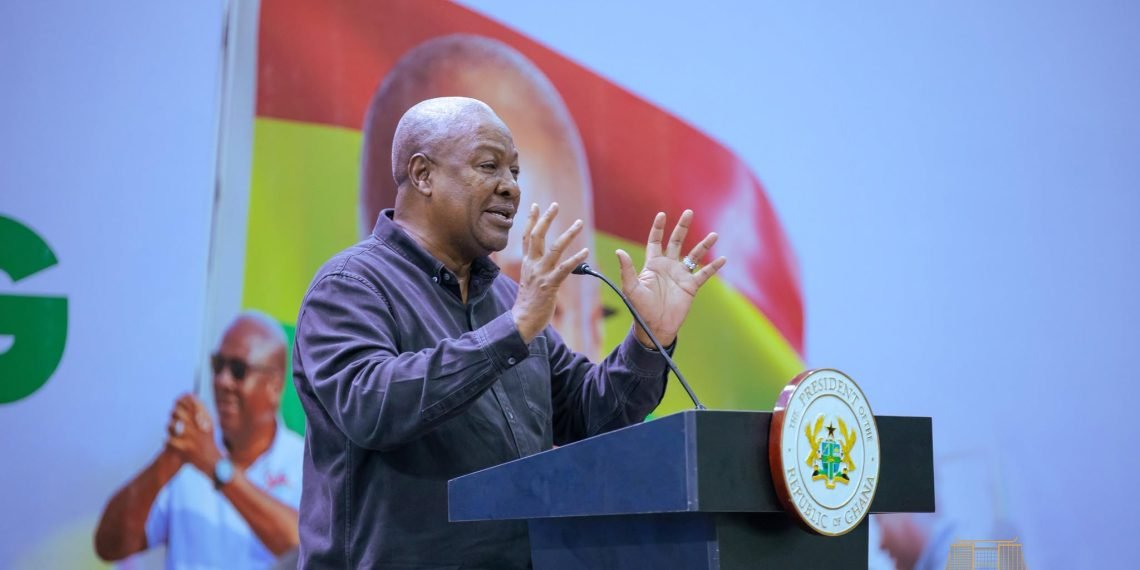
President John Dramani Mahama has rejected claims that his government has approved a policy to introduce Arabic and Chinese as subjects in Ghana’s public schools.
According to John Mahama, no such policy had been approved by Cabinet and urged the public to disregard reports suggesting that the two languages were being introduced nationwide.

Mahama’s clarifications, however, contradict the Education Ministry position who had earlier clarified that the government’s language of instruction policy for basic schools does not intend to make Arabic and Chinese languages compulsory.
On August 2, 2026, in a statement issued by Hashmin Mohammed, Press Secretary to the Minister, disclosed that in the revised basic school curriculum, Ghanaian languages will be the primary medium from Kindergarten (KG) to Primary Three and used alongside English from P4 to P6.
The Education Ministry clarified that foreign languages such as French, Arabic, and Chinese will not be compulsory subjects but will instead be offered as optional courses for pupils who wish to acquire additional language skills, subject to the availability of qualified teachers and resources in their schools.
However, President Mahama on Saturday, September 12, during a citizens’ engagement at the University of Business and Integrated Development Studies (UBIDS) in the Upper West Region, as part of his Resetting Ghana Tour, boldly stated that, “No such policy has been approved by the cabinet that I chair. So let’s put that matter to rest once and for all”.
Mahama further questioned the rationale for introducing Chinese at a time when Ghana was already struggling to provide enough teachers to effectively teach French.
According to Mahama, French remains particularly important because of Ghana’s proximity to several Francophone countries.
“We’re not even getting a handle on the teaching of French. Why would we go and introduce Chinese?” he asked.
Mahama further clarified that Arabic being taught in some schools is not the result of a new policy to introduce the language across all public schools.
He explained, “There is training of Arabic teachers because, in Rawlings’ time, we noticed that the Muslim communities were not sending their children to school.
They were not sending their children to school because they were afraid that their children would be converted to some other religion. So, Rawlings introduced English-Arabic schools. They allowed Arabic to be taught in those schools”.
“But there’s no new policy to introduce Arabic and Chinese in all public schools in Ghana,” he said.
Read the Education Ministry ealier statement below:
“MINISTRY OF EDUCATION CLARIFIES LANGUAGE OF INSTRUCTION POLICY FOR BASIC SCHOOLS
1. The Ministry of Education wishes to clarify the Government’s language of instruction policy for basic schools following public discussions and misconceptions regarding the use of Ghanaian and foreign languages in the country’s education system.
2. In the proposed revised curriculum, Ghanaian languages will serve as the primary medium of instruction from Kindergarten (KG) to Primary Three. This policy is intended to strengthen children’s foundational literacy, numeracy, critical thinking, and overall cognitive development by enabling them to learn in a language they understand best during their formative years.
3. From Primary Four to Primary Six, both Ghanaian languages and English will be used as the medium of instruction. This bilingual approach is designed to support a smooth transition to higher levels of education, where English assumes a greater role, while preserving learners’ competence in Ghanaian languages.
4. The Ministry further clarifies that foreign languages such as French, Arabic, and Chinese, among others, are not compulsory subjects. They will be offered as optional languages for pupils who wish to acquire additional language skills, subject to the availability of qualified teachers and learning resources in their respective schools.
5. The language policy is informed by internationally accepted educational practices, which recognise that children learn best when they begin their education in a familiar language before gradually transitioning to additional languages. It also aligns with Ghana’s commitment to improving literacy outcomes, promoting multilingualism, and preserving the nation’s rich linguistic and cultural heritage.
6. The Ministry urges parents, teachers, school authorities, media organisations, and the general public to disregard misinformation suggesting that foreign languages have been made compulsory in the proposed revised curriculum.
7. The Ministry remains committed to implementing evidence-based education policies that improve learning outcomes and equip every Ghanaian child with the knowledge, skills, and competencies needed to thrive in an increasingly interconnected world.
Signed;
Hashmin Mohammed
Press Secretary to the Hon. Minister”
Watch the video below:
“There’s absolutely no new policy to introduce Arabic and Chinese” — Mahama
— CITI FM 97.3 (@Citi973) September 12, 2026
President John Dramani Mahama has dismissed claims that Arabic and Chinese are being introduced into Ghana’s school curriculum, saying no such policy has been approved by Cabinet.#ChannelOneNews… pic.twitter.com/KWF3ifF3Qy
@ghnow_ Hon. Alan Kyeremanten spotted at the funeral of Mrs Alice Serwaa Manu #GHNow #fyp ♬ original sound – GHnow
@ghnow_ NAPO Arrives at Mrs. Alice Serwaa Manu’s Funeral #GHNow #fyp ♬ It Is Finished – Kofi Kinaata