

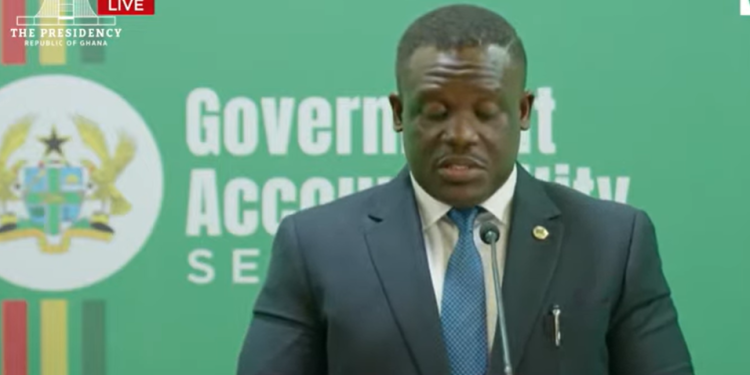
Sam George, the Minister for Communication, Digital Technology and Innovations, has announced that all TV stations on Ghana’s National Digital Terrestrial Television (DTT) platform will pay a US$7,000 monthly tariff effective January 2027.
According to Sam George, the new charge forms part of a sustainable cost-sharing framework developed following a comprehensive review of the national DTT platform.

The Communication Minister disclosed that a committee established after the review recommended a graduated tariff support mechanism to complement the existing subsidised national tariff.
He highlighted that the proposal is aimed at creating a more sustainable financing model for the DTT platform while maintaining support for television stations during the transition.
Speaking at the Accountability Series on Monday, September 7, Sam George stated, “I set up a committee, and that committee has recommended a sustainable cost-sharing framework and a graduated tariff support mechanism to complement the subsidised national tariff, which will see all TV stations on our DTT platform pay US$7,000 per month during the initial implementation years in a graduated manner”.
In other issues, Sam George, has announced that MTN Ghana will invest over $1.1 billion in network expansion and 5G rollout.
According to Sam George, the over 1.1 billion will be used to expand and improve the telecommunications network, including the rollout of 5G services across the country.
The Communications Minister disclosed that the investment forms part of efforts to address persistent network challenges and improve connectivity.
Sam George highlighted that the scale of the investment demonstrates a significant commitment by MTN Ghana to strengthening its network infrastructure.
Speaking at the Government Accountability Series on Monday, September 7, Sam George stated, “MTN Ghana has committed more than $1.1 billion over the next three years, including roughly $380 million this year to expand coverage, deploy new sites and support 5G rollout”.
“We have 800 new cell sites in total, the highest annual build the company has undertaken in a decade, particularly at the rural and peri-urban communities where network challenges have been most pronounced”.
“I personally worked with Members of Parliament to mark the specific locations most affected in their constituencies, the first time such an exercise has been done at this scale, and 180 of those sites are already active and carrying traffic today.”
Also, Sam Nartey George has said the government’s Big Push programme has been responsible for nearly half of all fibre cuts recorded in Ghana.
He highlighted that the frequent damage to fibre networks was disrupting telecommunications services and imposing significant repair costs on operators.
Sam George argued that those resources could otherwise be channelled into expanding network coverage.
The Communication Minister explained that road construction accounted for about 49% of all fibre cuts, making it the single biggest source of damage to telecommunications infrastructure in the country.
He stated, “That’s money that without the fibre cut we could have used to build new sites… The biggest source of fibre cuts is from the Big Push project because the Ministry of Roads is carrying out an aggressive project to construct roads across the country”.
“25 per cent of fibre cuts are a result of galamsey. The telecom industry is one of the worst hit by the activities of galamsey operators. They [galamsey operators] just go in and make cuts. Road contractors will often report fibre cuts but galamsey operators won’t report it, and that is a real challenge to the sector.”
@ghnow_ Free primary healthcare does not mean free universal healthcare #GHnow #fyp ♬ original sound – GHnow
@ghnow_ Free primary healthcare dis not mean free universal healthcare #GHnow #fyp ♬ original sound – GHnow