

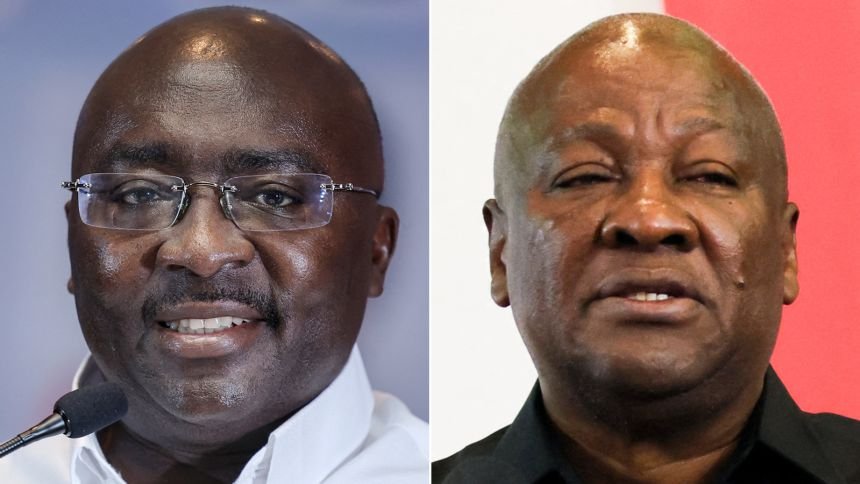
Dr Mahamudu Bawumia, the flagbearer of the New Patriotic Party (NPP), has cautioned President John Mahama against using its majority in Parliament as a basis for passing every piece of legislation before the House.
The NPP flagbearer highlighted that the Mahama government commands the most overwhelming majority in Parliament; however urged that every bill can be passed, but not every bill must be assented to.

Addressing the nation on Sunday, July 19, Dr Bawumia stressed that the ability of Parliament to pass legislation does not automatically mean every proposed law should receive approval.
Dr Bawumia stated, “Mr President, your government commands one of the largest majorities in the history of the Fourth Republic. With such numbers, Parliament can pass almost any bill it wishes. Not everything that can be passed should be passed”.
“History will not ask how many votes a law received. It will ask whether the law is just, equitable, and seeks to promote and protect the interests of Ghanaians,” Dr Bawumia added.
Also, Dr Bawumia made a direct appeal to President John Dramani Mahama not to assent to the recently passed Tribunals Bill.
According to Dr Bawumia, the legislation with such far-reaching consequences should first be subjected to extensive national consultation.
Dr Bawumia stressed that the Tribunal Bill should not become law until key stakeholders have had the opportunity to deliberate on its implications, adding that reforms affecting Ghana’s justice system should be built on broad public consensus rather than a parliamentary majority.
The NPP flagbearer highlighted that the judiciary remains one of the country’s most important democratic institutions, noting that any changes to its structure should be approached with transparency, inclusiveness and careful consideration.
Dr Bawumia further urged him to delay assent and instead open the door for nationwide dialogue.
The former vice president stated, “The bill will soon be transmitted to the president for his assent, and I have one respectful request of President Mahama. Mr President, do not assent to this bill. Pause and let the nation ponder and deliberate on this very important matter.
“This is not a partisan request. The Trades Union Congress and the voice of millions of Ghanaian workers have called for the bill to be withdrawn, warning that in its current form, it could become a potent tool for weaponising justice delivery.
“Those are the words of Ghanaian workers, not of any political party. Consider also the government’s own process. The president established the Constitution Review Committee, and it recommended removing regional tribunals from the constitution because the High Court has long carried their case loads.”
“My call is simple and constructive: withhold your assent. Convene genuine national engagement. Invite the Ghana Bar Association and other lawyer groups, Organised Labour, CSOs and the political parties, including my own, and we will come in good faith and consult the judiciary itself.
“Justice belongs to no government and no party; it belongs to the Ghanaian people, and a law that reshapes the architecture of justice should rest on national consensus and not a headcount”.
“Mr President, the pen is in your hand; use it not to assent to this bill but to write an invitation to the nation.”
Meanwhile, the minority Leader, Alexander Afenyo-Markin, before the passage of the bill, called for the deletion of a key provision in the proposed Tribunals Bill, 2026.
According to him, the creation of district and regional tribunals would establish a parallel justice system and undermine Ghana’s existing judicial architecture.
Alexander Afenyo-Markin warned that the Tribunals Bill will create chaos in justice delivery.
Afenyo-Markin stated, “Mr Speaker, I move that the entire Clause 4 be deleted?”.
“My reason is very simple.”
He argued that while Articles 125 and 126 of the Constitution recognise the possibility of establishing tribunals, they do not compel Parliament to create them, adding that the House should instead strengthen the existing court system rather than establish new institutions that could create uncertainty in the administration of justice.
“What kind of chaos are we introducing?” he asked.
“You have a district court, you have a circuit court, you have a high court, you have a court of appeal, you have a judiciary architecture that is not broken.”
“The disagreement we may have with certain pronouncements of certain judges… does not mean that we create some parallel structures that we call a justice system,” he said.
“How on earth do we create a new system to compete with a known system just because somewhere in the Constitution certain pronouncements are made?” he asked.
“The Constitution says Parliament may determine,” he said. “I am saying that this Parliament must know that the justice architecture we have is not a broken architecture.”
“I contend that creating this new tribunal system by this proposal will bring chaos to the justice delivery system we have in our country,” he said.
Watch the video below:
@ghnow_ Bawumia cautions Mahama against reinstating regional tribunals.
♬ original sound – GHnow
@ghnow_ Prophet Eric Uche-Boahen has weighed in on the political undertones surrounding the 2026 FIFA World Cup final, claiming that recent international political developments could influence the outcome of the tournament. According to him, Israel’s Prime Minister’s reported declaration of support for Argentina, coupled with comments attributed to former U.S. President Donald Trump against Spain, may pose spiritual and political challenges for the Spanish side.
♬ original sound – GHnow
@ghnow_ Former Black Stars defender George Blay has been laid to rest in a private ceremony attended by close family members in Gaithersburg, Maryland.
♬ original sound – GHnow