
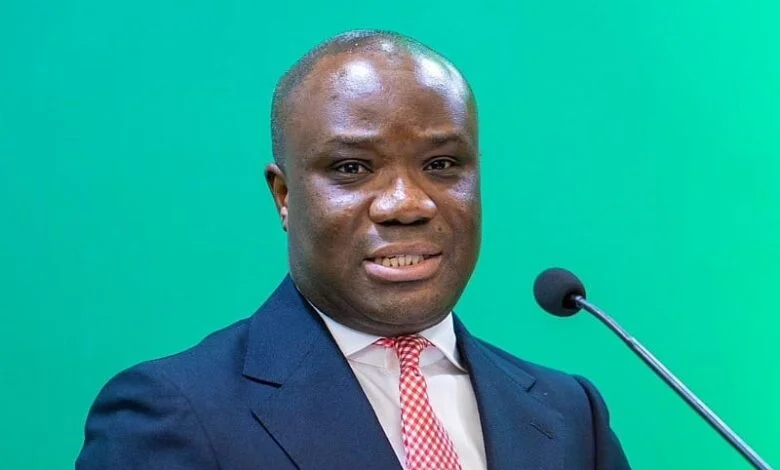
Felix Kwakye Ofosu, the Minister of Government Communications and Member of Parliament for Abura-Asebu-Kwamankese, has clarified the confusion between the Mahama government’s 24-hour economy and its proposed New Economy programme.
According to Kwakye Ofosu, although the two programmes may have some areas of overlap, they are fundamentally different in their objectives, implementation and scope.

He explained that the 24-hour economy is primarily a private sector-led initiative designed to encourage businesses to operate around the clock through government incentives.
Kwakye Ofosu stressed that the initiative seeks to support private businesses to introduce shift systems and extend their operating hours, allowing them to maximise productivity while employing more people.
Speaking in an interview with Joy News ahead of the 2027 budget reading in parliament on November 12, 2026, Ofosu Kwakye stated, “The 24-hour economy, even though it is a government initiative, is primarily aimed at the private sector. So, the government said that we think this economy can work in a manner that it does not sleep and that it can run around the clock”.
“To be able to do that, we need to provide incentives to private sector companies, mostly, who can then take advantage of it, expand their businesses, and in the process employ more people”.
He further disclosed that about 33 major private businesses and companies had registered with the 24-hour economy secretariat, with some already implementing the initiative.
On the New Economy programme, Ofosu Kwakye revealed that it was a long-term government initiative focused on restructuring Ghana’s economy through strategic investments in selected growth sectors.
According to him, the New Economy programme would involve setting aside $10 billion to finance specific growth pillars.
He explained, “The new economy is a government programme lasting for years, through which 10 billion dollars will be set aside to finance specific growth pillars to transform the structure of our economy, make us a value-added economy and also ensure that through the process we create quality jobs for Ghanaians”.
“The new economy essentially revolves around government investment in critical areas that will ensure that we grow our economy on a consistent, more reliable, predictable basis and then through that churn out quality jobs for the teeming youth of this country.
“Through that also, we give our people a much better standard of living, and then move away from this perennial, cyclical economic crisis that we fall into,” he said.
Meanwhile, Kwesi Pratt, a veteran journalist, has questioned whether the government’s proposed ‘new economy’ agenda signals a departure from its flagship 24-hour economy policy.
The veteran journalist demanded clarity on what the ‘new economy’ concept means and how it relates to the promises made ahead of the 2024 general elections.
Kwesi Pratt expressed concern over the introduction of the new economic agenda, particularly if it meant the government was moving away from commitments made to Ghanaians during the election campaign.
Speaking on Metro TV’s Good Morning Ghana on November 11, 2026, Kwesi Pratt stated, “What he (Ato Forson) is bringing tomorrow is something called the new economy. And I’m wondering, what is that? The new economy, what is that? Is that a departure from the promises which were made before the 2024 elections?”.
Kwesi Pratt argued that if the government had realised that some of its campaign promises were no longer achievable, it had a responsibility to return to Ghanaians and explain the reasons for changing course rather than introducing a new agenda without adequately clarifying its implications.
He added, “If at any point the government realises that those promises cannot be fulfilled, government needs to come back to us and say, ‘Look, you gave us a mandate to do this.’ We’ve been in office, we’ve seen that the promises we made were not realistic. We are abandoning it and going for something called the new economy”.
The Veteran journalist further suggested that the term ‘new economy’ could be another catchy political expression introduced ahead of a budget presentation.
He, however, insisted that Ghanaians deserved to know whether it represented a fundamental shift in the government’s economic policy.
Kwesi Pratt argued that after two years in office, the government should be using its budget presentation to account for the progress made towards fulfilling its campaign promises, particularly the establishment of the 24-hour economy.
According to Kwesi Pratt, the policy was presented as a major vehicle for creating employment, and the government should therefore provide an update on the steps taken to make it a reality.
He added, “We want the mandate to establish the 24-hour economy. That was supposed to be the main vehicle for generating employment. We’ve been in power for two years. These are the things that we have done to make sure that the 24-hour economy promise, which was a game-changer, is on course”.
Black Stars coach Kim Lars has departed Transition Funeral Home following the burial service of Thomas Partey’s father. https://t.co/wq7Q8fAo4m
— GHnow (@ghnow_) November 13, 2026
Former Black Stars captain Andre ‘Dede’ Ayew has arrived at Transition Funeral Home to pay his last respects to the late father of Thomas Partey #GHNow https://t.co/eWB063XjdO
— GHnow (@ghnow_) November 13, 2026