

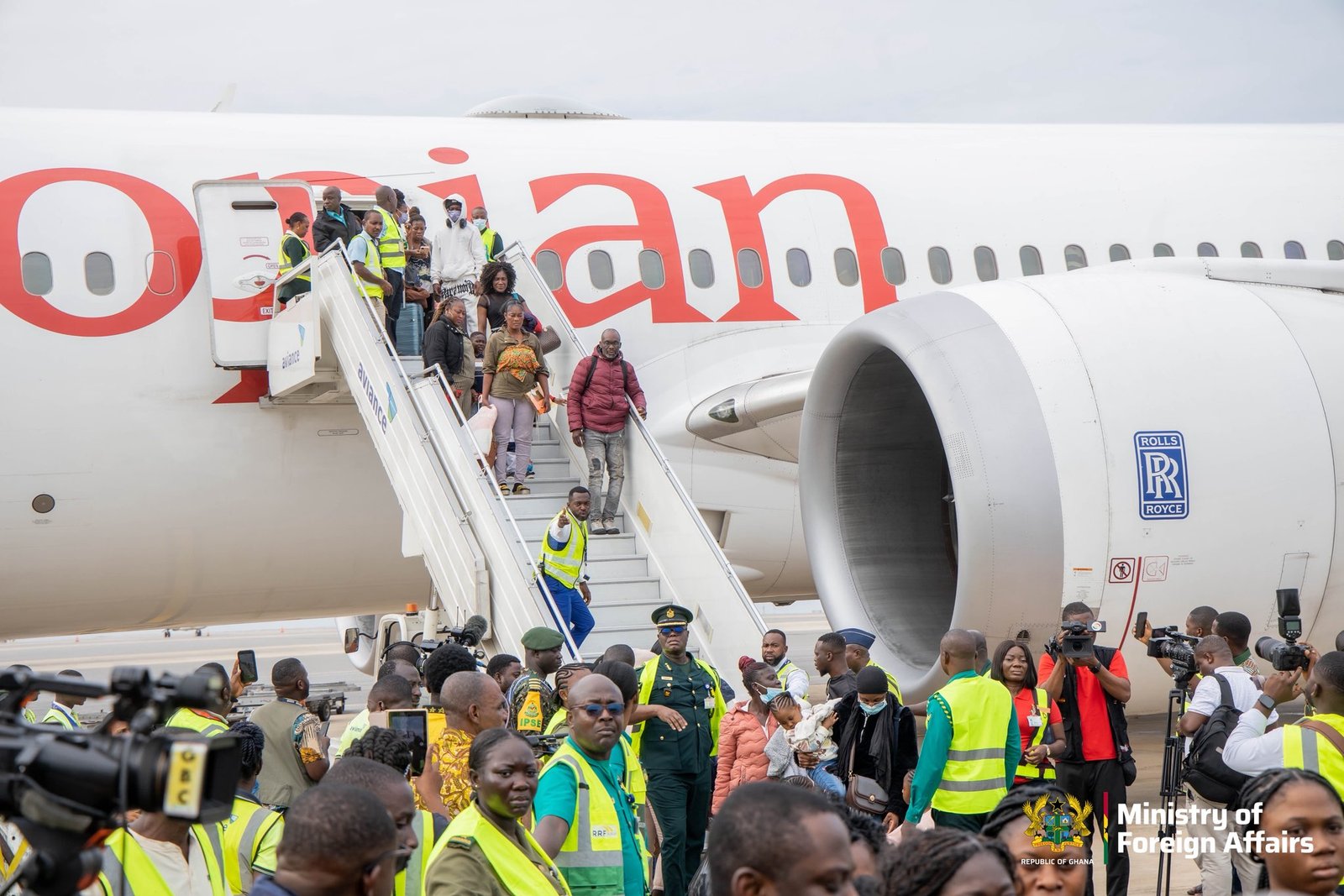
H.E. Benjamin Quashie, Ghana’s High Commissioner to South Africa, has revealed that Nigeria is expected to begin evacuating its citizens from South Africa next week.
Speaking on Citi Eyewitness News, Benjamin Quashie stated, “A lot of them are following what we have done. I am aware that Nigeria will be evacuating its citizens next week”.

He further revealed why the Ghana government decided to begin evacuating Ghanaians from South Africa after continued unrest and hostility.
Ghana’s High Commissioner to South Africa revealed that Ghanaian authorities initially engaged South African officials to find solutions to address the growing tensions.
However, the situation persisted despite expectations that the demonstrations would subside.
“We realised that in our engagement with the South African authorities, while we were offering solutions to what was happening, they took an entrenched position. But it kept happening, and most of our people had economic challenges,” he stated.
“When we got to the point where we realised if we don’t take a stance it will hurt our people, that was where we decided to start evacuating those who want to go home,” he added.
He added, “I must say it went well and we are continuing with the evacuation of all our citizens who want to go home voluntarily”.
“The government of Ghana cares about its citizens both home and abroad, and we have a President and a Foreign Affairs Minister who care deeply about what Ghanaians go through abroad,” he added.
Benjamin Quashie remarks come on the heels of criticism from some South African politician, Julius Malema, who has claimed that Ghana overstated its decision to evacuate its nationals.
Leader of South Africa’s Economic Freedom Fighters (EFF), Julius Malema, in a viral video, fumed at the government of Ghana over the evacuation of 297 Ghanaians from South Africa.
According to Julius Malema, the response of the Ghanaian government was not necessary as it creates an impression that “we are all like that”.
He further argued that South Africa should not respond in the same way, saying Ghana’s approach does not reinforce dialogue and diplomatic engagement.
Speaking to the media, Julius Malema argued, “The Ghana response was not necessary; it now creates an impression that we are all like that. But it is a certain section of our society that needs to be contained by law enforcement.
One Ghanaian lady was saying I wouldn’t have taken this option, but the problem was that we are being beaten in front of the Police, and the Police are not doing anything. That is a problem. When this opportunity came for me to leave, I left.
Because if the Police cannot defend me, it means the state is in agreement with the people who are beating me”.
He added, “We will resolve this; the President of Ghana should have given us some time to deal with this matter. And we will get to the bottom of it; we hope they will come to their senses. We don’t have to respond the same way they did; we need to pursue diplomatic engagement with Ghana.
We don’t think Ghana reacted in a manner that reinforces disloyalty and diplomatic engagement; it actually creates a very bad extreme situation, which is not. It is a select few we are pursuing and persuading the government to act on those few.
They must give use sometime, and those who don’t feel safe, especially the legally documented Ghanaians, should be able to run to the police station for safety. The reaction of the government should have been postponed to give us an opportunity to deal with what is happening in South Africa”.
Watch how Ghanaians facing xenophobic attacks in South Africa left South Africa to Ghana #GHNow pic.twitter.com/dBsvDbKlg5
— GHnow (@ghnow_) May 28, 2026