

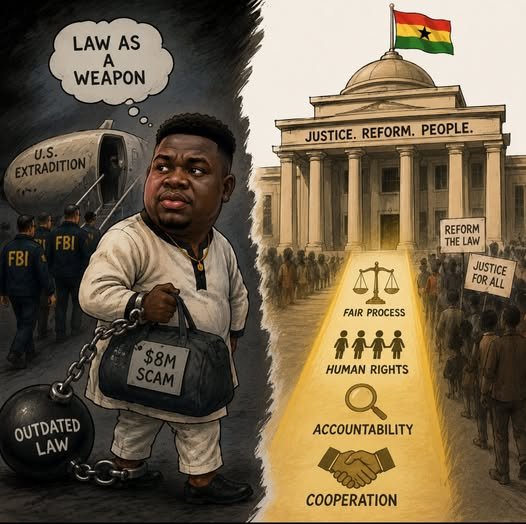
Amanda Clinton, a renowned legal practitioner, has said anyone who cares about due process should be worried about Ghanaian socialite Abu Trica’s extradition to the United States.
According to Amanda Clinton, Ghana must not become a conveyor belt for foreign prosecutors, warning that Ghana risks becoming a ‘rubber stamp’ for foreign prosecutions.

Amanda Clinton argued that it is not about defending fraud, but about whether the process that led to Abu Trica’s removal from Ghana was fair, lawful and meaningful.
She highlighted the speed at which Abu Trica was put on a plane, noting that if the process began around July 2, the law allowed a 12-day window for further legal action.
In a Facebook post following Abu Trica’s extradition on July 9, 2026, Amanda Clinton raised serious concerns about the manner in which Abu Trica was extradited to the United States.
Amanda Clinton, in her long post, wrote, “Ghana Must Not Become a Conveyor Belt for Foreign Prosecutors.
The Abu Trica extradition should worry anyone who cares about due process.
This is not about defending fraud. Ghana must never become a hiding place for people accused of romance fraud, cyber fraud, money laundering, or any form of transnational crime. If a person has a case to answer, let them answer it.
But extradition is not supposed to be automatic. It is not a matter of America asking and Ghana simply handing someone over.
Under Ghanaian law, extradition is a legal process. It is governed by the Extradition Act, 1960, Act 22, the Constitution, and any relevant treaty or arrangement. So the important question is not just whether a court approved the extradition. The real question is whether the whole process was fair, lawful, and meaningful.
That is why the timeline matters.
If the process began around 2 July, and the law allowed a 12-day window for further legal action, then the speed of the surrender raises serious questions. It has been reported that on 8 July, his lawyer was told by BNI officials to return the next morning. Yet by dawn on 9 July, the lawyer allegedly discovered that Abu Trica had already been flown out to the United States.
If that account is correct, the State owes Ghanaians a clear explanation.
Habeas corpus is not a mere technicality. It is one of the most important protections against unlawful detention. It allows a detained person to ask a court: why am I being held, and is my detention lawful?
In extradition matters, that protection is even more important. Once a person is put on a plane and sent abroad, Ghanaian courts can no longer give any meaningful protection. The matter becomes practically irreversible.
So yes, a court may approve extradition. But that does not mean a person should be rushed from the courtroom to the airport. After the court stage, the executive still has duties. There must be proper procedure, access to counsel, and respect for any pending legal steps.
If Abu Trica had a live stay application, an intended appeal, a human rights application, a habeas corpus issue, or an unresolved complaint about access to his lawyer, then the State must answer some basic questions.
Was the stay application heard before he was removed? Was it dismissed? Was there no effective stay order in place? Was his lawyer allowed proper access to him? Was the ministerial surrender warrant properly issued? Was the court process allowed to work in any real sense before he was flown out?
Of course, filing a stay application does not automatically stop extradition. A court must normally grant the stay. So the State may argue that once no stay had been granted, it was free to proceed.
But that answer may still be too simple.
If an emergency application had already been fixed for hearing, and the person was removed before the hearing could serve any useful purpose, then the issue becomes more troubling. The question is whether the State followed the letter of the law while defeating the protection the law was meant to provide.
That is where the danger lies.
Ghana’s Constitution protects liberty, dignity, due process, and access to counsel. A suspect does not lose those rights because the requesting country is powerful. Extradition may be lawful, but it must still be handled with constitutional discipline.
There is also a sovereignty point.
Ghana does not need a crude “Abu Trica for Ofori-Atta” exchange. Extradition should never become human barter. One person’s liberty should not be traded for another person’s political usefulness.
But reciprocity matters. Diplomacy matters. National interest matters.
If Ghana is surrendering suspects quickly to the United States, then Ghana is entitled to ask whether its own requests are being treated with the same urgency and seriousness. That is not anti-American. It is basic sovereign equality.
The question, then, is not only whether Ghana had the legal power to extradite Abu Trica. The deeper question is whether Ghana is using that power wisely, or whether we are slowly becoming a conveyor belt for foreign prosecutors.
There is a difference between cooperation and submission.
Ghana should work with the United States and other partners to fight serious crime. But that cooperation must have conditions. There must be due process, access to counsel, fair trial assurances, specialty protections, consular access, transparency, and real reciprocity.
The old Ghana-U.S. extradition framework may still have legal relevance, but it is outdated for today’s world. Modern cases involve cybercrime, electronic evidence, digital privacy, money laundering networks, crypto trails, online fraud, and cross-border banking systems. Ghana needs a modern extradition and mutual legal assistance framework that protects both justice and sovereignty.
I am not saying extradition is wrong.
I am saying Ghana must not confuse legal cooperation with blind surrender.
If Abu Trica is guilty, let him face justice. But the process by which Ghana gives him up must itself be just.
A democracy is not tested by how it treats popular people. It is tested by how it treats unpopular suspects when powerful states are demanding them.
Ghana must not be a safe haven for fraudsters.
But Ghana must also not become an airport transit point for foreign prosecution.
Lawful cooperation, yes.
Due process, always.
Reciprocity, non-negotiable.
Blind surrender, no”.
See the post below:
@ghnow_ President Mahama joins the clean up exercise at Alajo #GHNow #fyp ♬ original sound – 🤍DAYSO LYRICS 🎤