

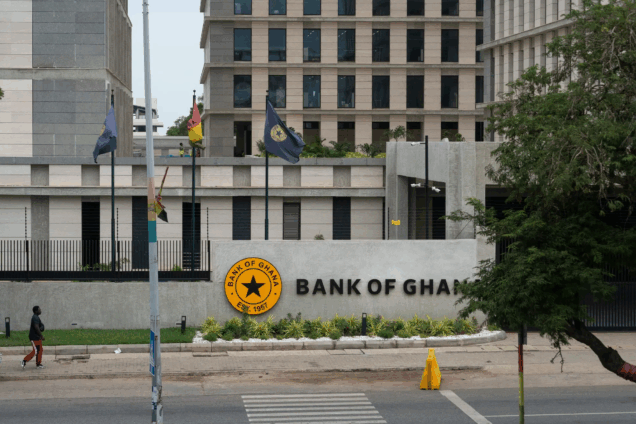
The International Monetary Fund (IMF) has revealed that the Bank of Ghana (BoG) sold $12.9 billion on the forex exchange market in the year to end-May 2026.
The IMF, in its report accompanying the sixth and final review of Ghana’s $3 billion Extended Credit Facility, made this known, revealing that $1.1 billion was injected by the BoG in a month, laying bare the scale of an intervention that propped the cedi against major currencies like the dollar.

IMF disclosed that the Central Bank “accumulated $3.9 billion and sold $12.9 billion in FX in the 12 months through end-May 2026,” while rebuilding reserves beyond programme targets.
It will be recalled that Ghana’s international reserves reached nearly 6 months of import cover at the end of 2025, and the cedi appreciated 40.7%.
Despite the scale of the dollar sales, the cedi has come under renewed pressure in 2026, depreciating about 10% against the dollar in the first seven months of the year.
Part of a JOYNEWS report read, “The IMF flagged a governance concern in how the intervention was carried out. While a new FX operations framework introduced in November 2025 had improved transparency, the Fund said, “auctions have frequently deviated from published guidelines by rejecting the highest bids.”
The scale of the dollar sales comes as Ghana leans heavily on gold to rebuild its external buffers, a strategy that has carried a steep cost. The central bank’s Domestic Gold Purchase Programme, run in tandem with the state-owned Ghana Gold Board, “has generated losses of GHS 22 billion (1.5 per cent of GDP) in 2025,” the report said.
Those losses, the Fund said, “coupled with higher costs of open-market operations and exchange rate valuation losses” from the appreciating cedi, “worsened the BoG’s negative equity position to 6.7 percent of GDP at end-2025.”
In February 2026, parliament adopted the Ghana Accelerated National Reserve Accumulation Policy, which sets a target of 15 months of import cover by 2028, to be met through increased domestic gold purchases. The IMF pushed back, saying reserves of that size “would not be advisable on precautionary grounds alone, given the non-negligible costs.” It noted that sterilisation costs already reached 1% of GDP in 2025 and would rise with further accumulation”.
Meanwhile, the cedi weakness raises the risk of higher pump prices, since fuel is imported and priced off the exchange rate.
The IMF also warned the central bank to proceed carefully with rate cuts, citing “potential second-round effects from the impact of the war in the Middle East on energy and fertiliser prices” and “persistent risks from the high exchange rate pass-through.”
Also, the central bank has begun reshaping its reserves, cutting the share of monetary gold in gross international reserves “from about one-third to under one-fifth” in the fourth quarter of 2025 and selling half of its gold holdings to improve the portfolio’s risk profile.
The IMF, in its report, urged the central bank to gradually reduce its footprint in the FX market, relax net open position limits and remove remaining capital flow measures.
They also noted that Ghana continues to maintain several multiple currency practices that distort the market, and urged a clear, time-bound plan to eliminate them.
In related news, the IMF has warned the Mahama government that its recent fuel subsidy could damage Ghana’s fiscal gains.
According to the IMF, the recent fuel subsidy measures must remain temporary and carefully targeted not to undermine Ghana’s fiscal gains.
The IMF warning was contained in its Staff Report submitted to the Fund’s Executive Board on July 27 ahead of Ghana’s Sixth Review under the Extended Credit Facility (ECF) programme.
The IMF Staff Report acknowledged Ghana’s improving macroeconomic outlook but warned that fuel subsidies should not become a permanent policy tool.
Parts of the report stated, “The recent fuel subsidy measures must be temporary and well targeted.”
“Ghana’s near-term growth and inflation outlook is favourable but subject to elevated downside risks.”
It also identified external threats including “commodity price volatility, geopolitical tensions (including from the war in the Middle East), and trade disruptions.”
On the domestic front, the IMF warned that “policy slippages, delays in the implementation of SOE reforms (including state-owned banks), and failure to safeguard the central bank’s balance sheet could undermine confidence.”
It further observed that “Several state-owned enterprises (SOEs) continue to pose large fiscal risks”.
@ghnow_ Minority MPs Join “Democracy Under Attack” Demonstration Or: Minority Members of Parliament have joined the “Democracy Under Attack” demonstration, alongside NPP supporters and other participants calling attention to their concerns over Ghana’s democracy. 🇬🇭 #GHNow #fyp ♬ original sound – GHnow
@ghnow_ Hon. Amed Shaibu Joins Minority MPs and NPP Supporters for “Democracy Under Attack” Demo #GHNow #fyp ♬ original sound – GHnow