

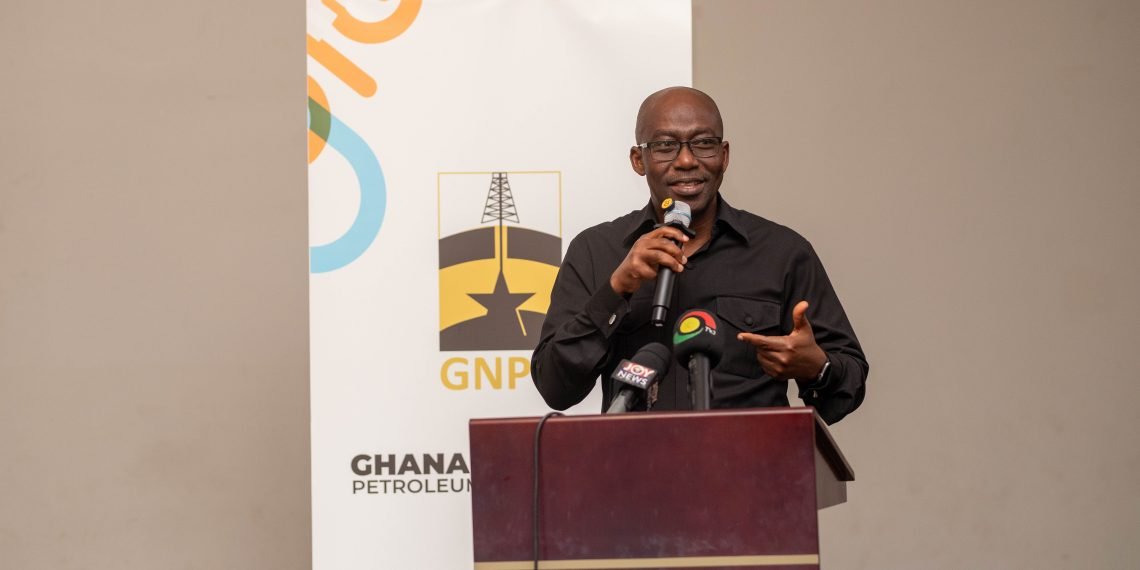
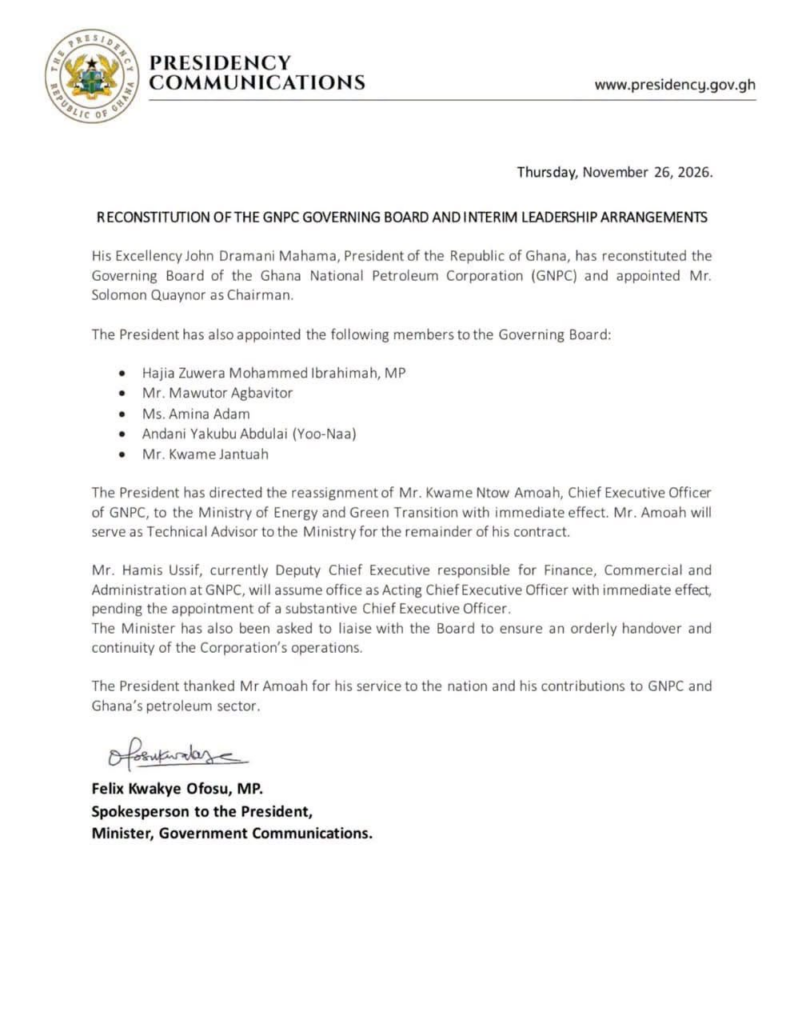
President John Dramani Mahama has reassigned the Chief Executive Officer of the Ghana National Petroleum Corporation (GNPC), Kwame Ntow Amoah, to the Ministry of Energy.
Kwame Ntow Amoah will now serve as a Technical Adviser for the remaining period of his contract.

The reassignment takes immediate effect, with Kwame Ntow Amoah expected to provide technical support to the Ministry in his new role.
Following the development, Hamis Ussif, the Deputy Chief Executive Officer responsible for Finance at GNPC, has been appointed to act as Chief Executive Officer until a substantive replacement is named.
Kwame Ntow Amoah assumed leadership of the state-owned petroleum company in February this year after his predecessor, Edward Abambire Bawa, was moved to GOIL as its Managing Director and Group Chief Executive Officer.
Before becoming CEO, Mr Amoah served as Deputy Chief Executive of GNPC and also worked at the Ministry of Energy as an Adviser to the Minister, where he held the position of Director of Petroleum.
He brings extensive experience in Ghana’s petroleum industry, having contributed to several major developments in the sector, including the country’s maritime boundary dispute with Côte d’Ivoire.
He played a significant role in Ghana’s successful arbitration case, which was decided in the country’s favour on September 23, 2017.
Mr Amoah was also involved in mobilising financing for major energy investments, particularly the Sankofa Oil and Gas Development Project, for which approximately US$7 billion was secured, including US$700 million in partial risk guarantees from the World Bank.
Meanwhile, President Mahama has undertaken changes to the governance structure of GNPC by reconstituting its Governing Board and appointing Solomon Quaynor as Chairman.
In related news, Professor H. Kwasi Prempeh, Executive Director of the Ghana Centre for Democratic Development (CDD-Ghana) and Chairman of the Constitutional Amendment Committee, has urged the John Dramani Mahama administration to introduce a transparent and competitive system for appointing chief executives and managers of State-Owned Enterprises (SOEs).
According to Professor H. Kwasi Prempeh, the appointments to leadership positions in the public sector should be based on merit, with clearly defined Key Performance Indicators (KPIs) used to assess the performance and retention of chief executives.
He argued that Ghana’s longstanding practice of relying on political affiliations and party networks to recruit managers for state-owned enterprises has failed to deliver the desired results and needs to change.
In a Facebook post, Professor Prempeh argued that although existing laws governing public sector appointments must be respected and enforced, a more fundamental reform would involve changing how chief executives and other senior managers are selected.
Professor H. Kwasi Prempeh argued that even if Ghana has not learnt any lesson in the past 70 years, the country has learnt that recruiting management of SOEs strictly through party networks and criteria has not helped the country.
In a Facebook post, H. Kwasi Prempeh wrote, “Fine, if that’s the law, then it must be enforced. For me, though, the more game-changing reform in the SOE/OSE sector is to base appointment and retention of CEOs and management generally on an open and competitive, meritocratic process driven by clear KPIs.
That’s what real reset in the SOE sector would mean. If we have learned nothing at all these 70 or so years, we at least should have learned by now that recruiting management of SOEs strictly through party networks and criteria, as we have done since the first SOE was established in the 1950s, has not helped this country, to put it mildly. “Insanity is doing the same thing over and over again and expecting different results.”
See the statement below:
Accra – Kumasi express way to be ready by end of 2028 #GHNow https://t.co/8EfSwLZ8f2
— GHnow (@ghnow_) November 25, 2026