

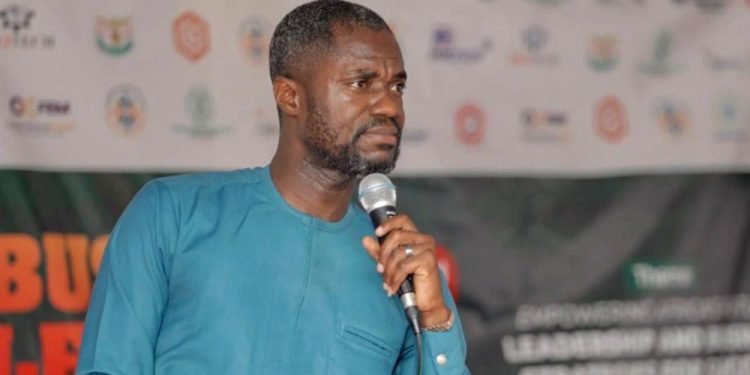
Dr Riverson Oppon, the CEO of COMAC, has said the fuel relief announced by the John Mahama government stems from operational margins of the activities of the industry players.
According to the COMAC CEO, he explained that the GH¢0.36 on petrol and GH¢2 on diesel are from operational margins of activities of the industry, as the government did not touch any tax or levies that go into the government coffers.
Speaking on PM Express on Joy News on Wednesday, he explained, “The relief of GH¢0.36 on petrol and GH¢2 on diesel is true, but let me also highlight the fact that this is a relief that stems from operational margins of activities of the industry, and it has not touched the government as it did not touch any tax or levies that go into the government coffers.”
This also means that NPA and even BOST would have to cough up external money to support this. So for me, the question here is whether this is a relief or pressure on institutions?”
He further added, “I believe that the ordinary Ghanaian will be happy. We are also happy because we buy fuel. But I think the term that we are giving it needs to be considered where there is no touch on tax.”
“Discounted diesel especially means that oil marketing companies will have to pre-finance the purchase and retailing of the product before the government pays us after roughly one and a half months.”
The COMAC CEO further highlighted concerns raised by regulators, “In today’s meeting with NPA, we made NPA aware that these are working capital of the industry, and therefore we want payment as fast as possible.”
“Assuming that one person lifts 10 million litres a month, that means that the person is in debt of GH¢603,000, which is more than half a million cedis that could have purchased fuel for retailing.”
“On the other hand, we are also going to negotiate with GRA since no tax was touched, we want to plead with GRA to also delay tax payments from our members or the industry, that’s the LPG and oil marketing companies, and that also brings some buffer onto what we are doing.”
“Is just unfortunate. Let me put it very unapologetically here. It’s just unfortunate that the downstream business is always receiving the burden for the government; we are the ones always coming to solve problems for the government.”
However, Spokesperson for the Ministry of Energy, Richmond Rockson, has disclosed that the government will lose an estimated GH¢200 million in revenue following its decision to reduce fuel prices.
According to Richmond Rockson, the decision by the President and Cabinet was a deliberate effort to prioritise the welfare of citizens, even at a financial cost to the state.
Speaking on Eyewitness News on Wednesday, April 15, Richmond Rockson explained, “This will lead to a net loss of about GH¢200 million that could have accrued to the government, but it is a necessary sacrifice to bring relief to the people of Ghana”.
His comments follow Felix Kwakye Ofosu, the Minister of Government Communications, who has announced that, effective April 16, 2026, which is the next pricing window, the Government will absorb GHC2.00 pes litre on diesel and GHC0.36 per litre on petrol.
According to Felix Kwakye Ofosu, intervention is intended to cushion customers and ease the cost burden on households, transport operators, and businesses.
In a statement signed by the Minister of Government Communications, Felix Kwakye Ofosu stated, “Effective April 16, 2026, which is the next pricing window, the Government will absorb GHC2.00 pes litre on diesel and GHC0.36 per litre on petrol. This intervention is intended to cushion customers and ease the cost burden on households, transport operators, and businesses.
The measure, approved by the Cabinet, is in response to rising prices of petroleum products on the international market, which have significantly impacted ex-pump prices in Ghana.
This temporary intervention will remain in force for a period of one (1) month. During this period, the government will continue to closely monitor developments in the global oil market and assess the need for further policy adjustments.
The government remains committed to maintaining price stability, protecting livelihoods, and supporting Ghana’s economic recovery in the face of external shocks”.
Watch the video below: