

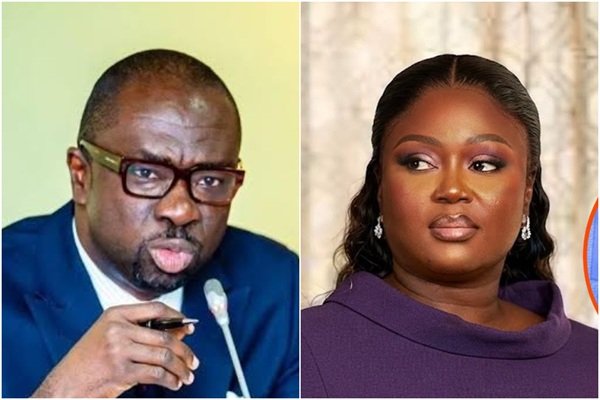
Private legal practitioner Professor Stephen Kwaku Asare, popularly known as Kwaku Azar, has weighed in on the state case against lawyer and Manhyia South MP Nana Agyei Baffour Awuah.
Prof. Azar particularly broke down the Manhyia South MP’s case, particularly the GH¢14.85 million judgment debt, a GH¢5 million settlement and a GH¢1 million cheque.

In his Facebook post titled “Republic v. Awuah Without Tears,” Prof. Azar examined the circumstances surrounding the settlement between SIC Life and Equity Savings & Loans.
He noted that the prosecution’s case disclosed that SIC Life was owed GH¢14.85 million by Equity Savings & Loans and had secured a court judgment against the company.
The prosecution further alleges that SIC Life subsequently attached a 31.93-acre property belonging to Equity, which had a reserve price of GH¢25 million, adding that while the property was under attachment, Equity allegedly purported to sell it to Eco Swiss for GH¢21.76 million.
Eco Swiss later challenged the attachment, resulting in a settlement involving SIC Life and the parties concerned.
He further questioned the rationale behind SIC Life accepting GH¢5 million to settle a GH¢14.85 million judgment debt, particularly when the attached property had a reserve price of GH¢25 million.
Kwaku Azar’s post forms part of his broader analysis of the prosecution’s case against Baffour Awuah and the financial transactions at the centre of the matter.
Read his full post below:
“REPUBLIC v. AWUAH WITHOUT TEARS
The prosecution has now put out its version of what happened in the SIC Life matter. These are allegations. They have not been proved. The accused has pleaded not guilty and is entitled to the presumption of innocence.
Here, GOGO breaks down the prosecution’s allegations.
1. SIC HIRES A LAWYER TO RECOVER ITS MONEY
SIC Life was owed money by Equity Savings & Loans. It hired the accused and his law firm to recover the debt. According to the prosecution, the fee agreement was straightforward:
The lawyer would receive 15% of the principal sum claimed as professional fees, plus 1% for expenses.
The prosecution calculates the 15% professional fee at ₵945,153. SIC had already paid ₵284,000 toward that fee.
2. SIC GOES TO COURT AND WINS
SIC obtained judgment against Equity. By May 2024, with interest and costs, the judgment debt had grown to ₵14.85 million.
SIC then attached Equity’s 31.93-acre property to recover its money.
“Attached” simply means the property was seized through the court process to satisfy the judgment. Equity remained the owner, but could not freely sell or otherwise dispose of it while the attachment remained in force.
The property had a court-approved reserve price of ₵25 million.
In simple terms, the prosecution’s position is this:
SIC was owed ₵14.85m and had attached property apparently worth enough to pay the entire debt.
An auction of the property was to follow to allow SIC to recover its money.
3. THEN SOMETHING INTERESTING HAPPENS
According to the prosecution, Equity did not wait for the auction. While the property was under attachment, Equity purported to sell the same property to Eco Swiss for ₵21.76 million.
“Purported” is not used casually here. The prosecution is saying that the property had already been attached in execution of SIC’s judgment, yet Equity nevertheless purported to sell it to somebody else.
The prosecution goes further. It alleges that Eco Swiss had not even been incorporated when it purportedly acquired the property.
And it alleges that the accused lawyer was instrumental in arranging the transaction.
4. ECO SWISS PAYS EQUITY ₵5 MILLION
By July 2024, according to the prosecution, Eco Swiss had paid Equity only ₵5 million of the ₵21.76m purchase price.
Eco Swiss then went to court and challenged SIC’s attachment of the property. The auction stalled.
Keep in mind that, according to the prosecution, the accused lawyer was at all relevant times acting for SIC, the judgment creditor trying to recover its money.
The prosecution alleges that although he knew of defects in Eco Swiss’s claim, he nevertheless actively encouraged SIC to settle.
One alleged defect is particularly important: property already under attachment cannot simply be alienated without leave of the court.
5. AND THEN COMES THE SETTLEMENT
SIC was owed ₵14.85m. It had attached property with a reserve price of ₵25m. The property had purportedly been sold for ₵21.76m.
Yet under the settlement, SIC agreed to accept ₵5m in full and final settlement of the ₵14.85m judgment debt.
This raises an obvious question: Why would SIC surrender a ₵14.85m judgment and its claim against the attached property for only ₵5m?
That question sits at the heart of the prosecution’s case.
6. BUT ECO Swiss WAS NOT PAYING ONLY ₵5 MILLION
This is where the prosecution’s story gets even more interesting. Under the settlement, Eco Swiss was actually undertaking to pay approximately:
₵5m — to SIC; ₵2.2m — to SIC’s lawyer; ₵1m — auctioneer’s fees for a Total of ₵8.2 million.
So although Eco Swiss was prepared to part with ₵8.2m under the settlement, SIC, the party that actually held the ₵14.85m judgment, was getting only ₵5m.
7. NOW REMEMBER THE ORIGINAL LAWYER’S FEE
According to the prosecution, the original engagement entitled the lawyer to 15% of the principal sum claimed.
The prosecution calculated that fee at approximately ₵945,153. SIC had already paid ₵284,000 toward it.
But the settlement allegedly did something different. It required Eco Swiss to pay the lawyer 15% of the original judgment debt, producing a legal fee of approximately ₵2.2 million.
So another obvious question arises:
How did a professional fee originally calculated at about ₵945,000 become approximately ₵2.2m?
And why was Eco Swiss, rather than the lawyer’s client SIC, paying it?
There may be answers. But these are questions the prosecution’s allegations naturally raise.
8. WHO AUTHORIZED THE SETTLEMENT?
The prosecution says SIC’s Managing Director signed the settlement. But investigators say they found:
No prior board approval. No shareholder approval. No subsequent ratification. No approval from the Ministry of Finance.
The prosecution alleges that the MD and the accused lawyer conspired in entering the settlement.
9. THEN COMES THE ₵1 MILLION CHEQUE
This may become one of the most closely watched parts of the case. According to the prosecution, after receiving his purported professional fees, the accused lawyer wrote a cheque for ₵1 million to the very person who had been SIC’s Managing Director and who had signed the settlement reducing SIC’s recovery from ₵14.85m to ₵5m.
The prosecution says the lawyer has not told investigators what that ₵1m payment was for. That does not establish that the payment was unlawful. There may be a lawful explanation.
But the prosecution is plainly asking the court to look at the entire sequence:
SIC has a ₵14.85m judgment.
SIC has attached property with a ₵25m reserve price.
Equity purportedly sells it for ₵21.76m.
Eco Swiss challenges SIC’s attachment.
SIC settles for ₵5m.
Eco Swiss separately pays approximately ₵2.2m to SIC’s lawyer.
The lawyer subsequently pays ₵1m to the SIC MD who signed the settlement.
That, stripped of the legal terminology, appears to be the prosecution’s theory of the case.
A charge sheet tells us what the prosecution alleges. It does not establish guilt. The prosecution must prove its allegations. The accused is presumed innocent and is entitled to challenge every part of this narrative.
Among the questions that will need answers are:
1. Why was ₵5m a reasonable settlement of the ₵14.85m judgment?
2. What was wrong, if anything, with continuing the attachment and auction?
3. What interest did Eco Swiss acquire in property that was already under attachment?
4. Why did the lawyer’s fee move from approximately ₵945,000 under the original engagement to approximately ₵2.2m under the settlement?
5. Why was Eco Swiss paying SIC’s lawyer?
6. What authority did the MD have to approve the settlement?
And perhaps most intriguingly:
7. What was the ₵1m payment from the lawyer to the former MD for?
The prosecution has told its story. The defence will have its opportunity to tell theirs. Then the evidence, not speculation, party colours or social-media passions, must decide the case.
We Summarize. We Don’t Judge.
PS: Yɛde post no bɛto hɔ. Yɛnyɛ comprehension consultants.
Da Yie!”
See the post below:
@ghnow_ Hon. Vincent Assafuah has questioned why individuals who were not NSA staff were allegedly issued visas under the National Sports Authority. #GHNow #fyp ♬ original sound – GHnow
@ghnow_ Hon. Vincent Assafuah has called for the immediate dismissal and prosecution of the NSA Boss, GTA Boss and the Sports Minister over the alleged visa scandal. #GHNow #fyp ♬ original sound – GHnow