
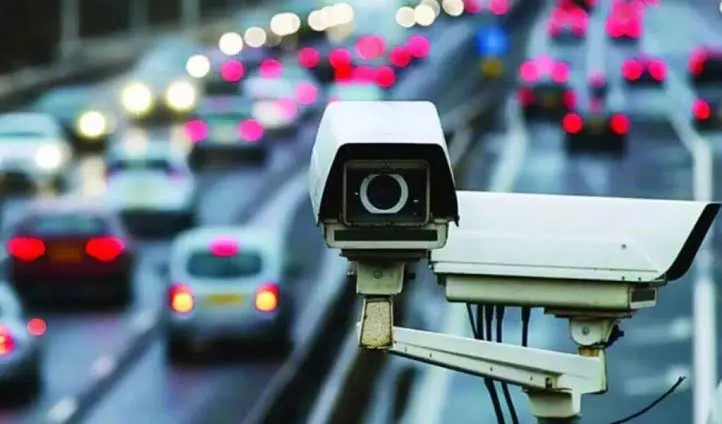
The Director-General of the National Road Safety Authority (NRSA), Abraham Amaliba, has said that the Traffitech system will, for now, only be deployed on roads where speed limits are clearly displayed.
According to the NRSA, the move is to avoid penalising motorists for the failure of authorities to provide the necessary road infrastructure.

He disclosed that the decision was intended to ensure fairness in the implementation of the digital traffic enforcement system.
Speaking on Joy FM’s Super Morning Show on Wednesday, November 4, Abraham Amaliba stated, “So we cannot use 21st-century digital policing to apply to 19th-century broken-down infrastructure. You know what that means. Our infrastructure is broken”.
“But we need to implement the digital Traffitech. So what we have agreed is that we’ll deploy the cameras to only the routes or streets that have the road signs and speed limits because it’s unfair to, as it were, punish a driver when you have not provided infrastructure,” he stated.
“So, for instance, if you’re on the Boundary Road, going up to the Mahama Road, you will see that there are traffic indicators, that there are speed limits there, 50 kilometres per hour. There, the cameras will catch you,” he said.
“But where we don’t have the road infrastructure, I mean the signs, the cameras will not be used in those places,” he explained.
“Our cameras are only on streets that have the speed limits,” he added.
“So it is only fair that we do not punish people for our own inadequacies.”
He further disclosed that the decision to restrict the cameras to roads with speed limit signs was discussed at a meeting on Tuesday, November 3, which brought together the Minister for the Interior, the Minister for Local Government, the Minister for Transport, the Police Motor Traffic and Transport Department (MTTD), the NRSA and transport operators.
He stated, “So there was a meeting yesterday [Tuesday]. That meeting brought together the Interior Minister, the Local Government Minister, the Transport Minister, the Police MTTD, myself and operators of our transport system”.
“At that meeting, it was made clear, and if you ask ACP Obeng, that has been the modus operandi. It was not explained for people to know that the cameras are only deployed in areas where the speed limits exist,” he said.
“There’s a Traffictech committee that meets, and before the rollout, this committee met regularly. And that committee is what did its work till this day, so we have the rollout,” he said.
Meanwhile, the Government of Ghana will receive GH¢60 out of every GH¢100 generated by the TraffiTech-GH revenue, while the private partner, NTMEL, retains the remaining GH¢40 under the revenue-sharing arrangement.
Reports suggest the arrangement forms part of an 11-year agreement valued at GH¢77.73 million, which is expected to run until December 2033.
Under the deal, revenue generated from the traffic camera system is shared between the government and NTMEL, with the state taking the larger portion of the proceeds.
According to the figures, for every GH¢100 earned through the system, GH¢60 goes to the government, while GH¢40 is retained by the private partner.
Also, under the original contract arrangement, NTMEL’s shareholders injected a further €550,000 in November 2024 to support the continuation of the project.
Reports suggest the additional funding was intended to keep the project running and sustain its operations.
The 60-40 deal has raised questions about the financial benefits to the state, the role of the private operator and whether the government could have pursued a fully state-funded alternative.
Also, the Traffitech-GH system, run by the Ghana Police Service’s MTTD, targets speeding, red-light running, and other violations with speed limits of 50 km/h in towns, 90 km/h on highways, and 100 km/h on motorways.
Lawbreakers will get 14 days to pay fines from GH¢120 for basics like speeding up to GH¢600 for phone use while driving or contest with evidence, building on a pilot that cut crashes.
Motorists have cheered the safety push, though some question the private operator’s 40% cut of fines and call for better roads and signage first.
@ghnow_ Ghanaian footwear brand Free the Youth President, Joey Lit has arrived at Black Star Fashion Week, currently underway at the Mövenpick Ambassador Hotel in Accra. #GHNow #fyp ♬ original sound – Nuel Lyrics 🎧❤️
@ghnow_ Renowned Ghanaian fashion designer Joyce Ababio has arrived at Black Star Fashion Week, currently underway at the Mövenpick Ambassador Hotel in Accra. #GHNow #BlackStarFashionWeek #fyp ♬ original sound – Bra. Zack