

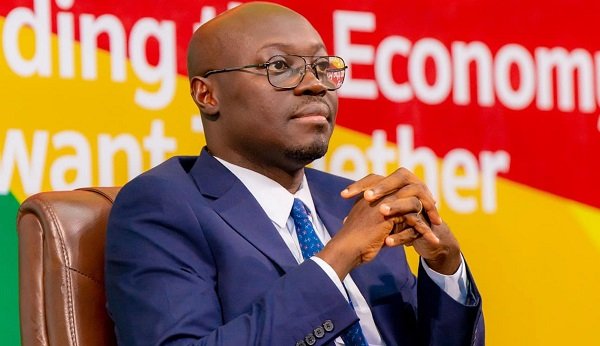
Dr Cassiel Ato Forson, Ghana’s finance minister, has announced that the Government of Ghana has since January 2025 paid $2.1 billion to Eurobond holders.
The Finance Ministry made this known while revealing that Ghana has settled a US$700 million Eurobond obligation ahead of its scheduled maturity.

According to the Ministry of Finance, the payment was made on Thursday, July 2, 2026, and comprised US$525.2 million in principal repayments and US$174.8 million in interest.
In a statement issued on July 6, 2026, the Finance Ministry detailed that with this latest transaction, Ghana has now paid a total of US$2.1 billion to Eurobond holders since January 2025, which is in line with the country’s Eurobond Debt Exchange Programme.
The Finance Ministry disclosed that the payment was executed through planned government financing arrangements, which did not place pressure on the country’s foreign exchange reserves.
Parts of the Finance Ministry press release read, “The payment was made through the Government’s planned financing arrangements without undue pressure on the country’s foreign exchange reserves. The settlement reduces Ghana’s outstanding Eurobond debt, strengthens investor confidence, and demonstrates the Government’s commitment to prudent debt management and macroeconomic stability.
The Ministry of Finance will continue to implement sound public financial management practices to ensure the timely servicing of Ghana’s debt obligations. The Ministry expresses its gratitude to the people of Ghana for their continued patience, support, and confidence,” the statement added.
In related news, Dr Cassiel Ato Forson, the Finance Minister, has stated that Ghana’s problem has always been borrowing.
According to Ato Forson, the country sometimes borrows just for consumption.
Ato Forson revealed he has no intention to rush back to the international capital market for loans.
He emphasised that Ghana must break the cycle of reckless borrowing, adding that borrowing must be deliberate and growth-focused.
Speaking on Joy News’ PM Express after presenting the 2026 Budget, Dr Ato Forson stated, “It has been Ghana’s problem, borrowing, borrowing, sometimes borrowing for consumption”.
He stressed. “I’m not one of those people. I’m not in a hurry to go to the capital market to borrow, no way. If I’m to take money, obviously there’s a budget, there’s a deficit to a stent, and you have to finance the deficit. I will take it domestically,” he said.
“We should be able to borrow and set up a domestic infrastructure board in cedi, so that you, if you have money and you want to support infrastructure, you should be able to support the government,” he said.
He added, “The appetite is not going into the capital market just to borrow. Like in the past, we saw it 3 billion every year.”
“You want to borrow smart, what does that mean? Borrow for things that you think the multiplier is better,” he said. “Let me put it simpler, not to borrow for shopping, okay, borrow for growth.”
Meanwhile, the World Bank last year warned the John Mahama-led government not to rush back to the Eurobond market.
According to the World Bank, international investors will see Ghana’s quick return to the World Bank as an easy way out.
The Bank urged the Mahama administration to fix Ghana’s economy to strengthen the country’s fiscal and growth fundamentals, and to convince the private sector that public debt is sustainable.
The World Bank stated, “Importantly, the new administration [Mahama Administration] should also refrain from a hasty return to the Eurobond market, which international investors would interpret as taking the easy way out,” the report said. “Instead, the government should focus on strengthening the country’s fiscal and growth fundamentals and on convincing the private sector… that public debt is on a sustainable path.”
“Sudden macroeconomic stops and crises have led the country to request a record number of IMF programmes, remaining under active IMF programmes for 40 out of its 68 years of history,” the Bank observed.
See the post below:
GOVERNMENT OF GHANA SETTLES US$700 MILLION EUROBOND OBLIGATION! pic.twitter.com/l5a22OokB5
— Cassiel Ato Forson (PhD) (@Cassielforson) July 6, 2026